.
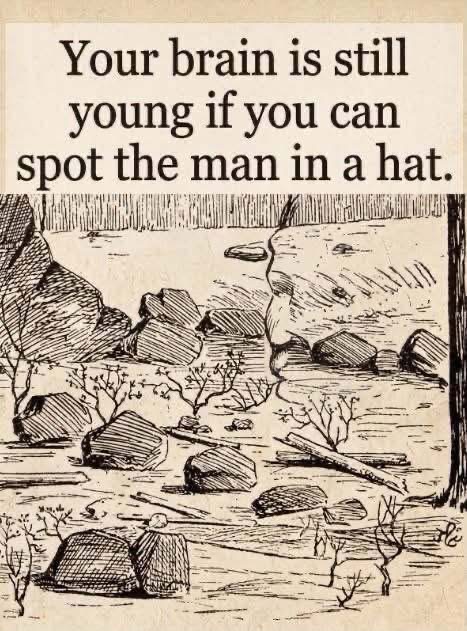
At first glance, this vintage-style landscape looks like nothing more than a peaceful outdoor scene.
There are large rocks in the foreground, dry ground stretching across the landscape, trees scattered in the distance, fallen logs, and a river or lake in the background. A small canoe carrying two people can also be seen moving across the water.
Everything appears ordinary.
Then you are told there is a man wearing a hat hidden somewhere in the picture.
Suddenly, the entire image changes.
The challenge isn’t simply to find a tiny person tucked behind a tree or concealed among the rocks. Instead, the man’s face and hat are formed by the larger shapes already present in the illustration.
That is what makes this optical illusion so fascinating.
You aren’t necessarily looking for something that was drawn separately.
You’re looking for something your brain has to assemble.
The Hidden Figure Is Hiding in Plain Sight
The puzzle’s challenge is often presented with the playful message that your brain is “still young” if you can spot the man in the hat.
But finding the hidden figure isn’t really a scientific test of how young your brain is.
Instead, it is a visual-perception challenge.
Different people can notice hidden images at different speeds, and many factors can affect how quickly someone recognizes an ambiguous shape. Familiarity with optical illusions, viewing distance, attention, and even the way the image is presented can all influence the experience.
So if you don’t see the man immediately, there is no reason to assume that anything is wrong with your vision or thinking.
The puzzle is designed to make the answer difficult to recognize.
Why Does the Image Look Like a Landscape?
The artist has deliberately constructed the scene so that the objects work in two ways.
At first, a rock simply looks like a rock.
A shadow looks like a shadow.
An empty area looks like empty space.
But when you change your perspective, those same shapes can begin to resemble parts of a human face.
This is an example of figure-ground perception, a principle in visual psychology describing how we distinguish a main object, or figure, from its surrounding background.
Normally, our brains separate these elements automatically.
In an optical illusion, however, the distinction can become ambiguous.
Leave a Reply