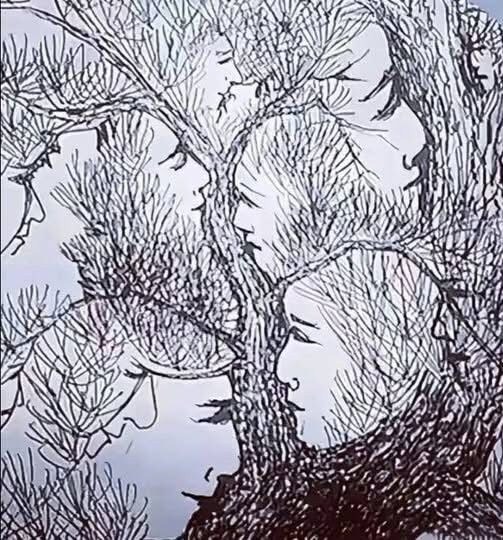
Have you ever looked at a tree, a cloud, or even a burnt piece of toast and thought you saw a human face smiling back at you? If so, you’re not alone. That strange and wonderful moment when your mind turns random shapes into something recognizable has a name — pareidolia.
It’s a quirk of the human brain that transforms ordinary objects into something meaningful. Some people see faces in trees, others spot animals in clouds or figures in rock formations. What might seem like imagination is actually a fascinating glimpse into how our perception works — and why only a rare few can quickly spot every hidden face in an image.
Pareidolia is the brain’s natural tendency to recognize familiar patterns — especially faces — in random or complex visuals. It’s a result of the brain’s pattern-recognition system, which evolved to help early humans detect predators, allies, and emotional cues instantly.
Our ancestors needed to react quickly to survive. Recognizing a face — even a false one — was far safer than missing a real one. Over thousands of years, that instinct became hardwired into our neural circuits.
Today, that same ancient system activates when you glance at a car’s front grille and see a “smiling face,” or when you look at a tree trunk and notice what appears to be an old man’s profile staring back at you.
Interestingly, scientists have found that pareidolia triggers the same regions of the brain that respond to real human faces — particularly the fusiform face area (FFA), which is responsible for facial recognition. That’s why these illusions feel emotionally real even when we know they’re not.
The Tree Illusion: Nature’s Hidden Canvas
One of the most popular examples of pareidolia today is the tree illusion — an image where faces appear to be carved naturally into the bark, branches, or roots. At first glance, it’s just a tree. But when you focus, human profiles start to appear: a pair of eyes, a nose, lips, even the outline of hair.
Artists and photographers have embraced this phenomenon, creating breathtaking “hidden face” artworks that challenge the brain to spot every subtle detail. These illusions are often shared online with captions like “Only 0.1% of people can find all the faces!” — and for good reason. They’re not just visually stunning; they’re psychologically engaging.
Some tree illusion artworks feature:
Lovers intertwined in the curves of the branches
Elders with wise expressions etched into the bark
Children laughing within the roots and lower leaves
Guardians or spirits peering from the hollow spaces
Each hidden face reveals itself slowly, rewarding patience and attention to detail — two qualities that keep viewers captivated. That’s exactly why these visual puzzles perform so well online: they hold attention, increase engagement, and spark conversations.
Leave a Reply