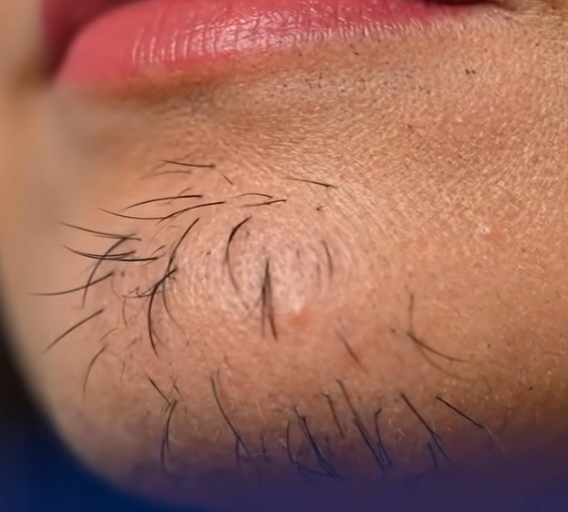
.
1. Aging Can Change Facial Hair Growth
As women get older, their hormone levels gradually change. During perimenopause and after menopause, declining estrogen levels can influence the balance between different hormones.
Androgens, including testosterone, are naturally present in women. These hormones can affect hair follicles, sometimes encouraging them to produce thicker, darker hairs on the chin or upper lip.
Consequently, a woman who rarely noticed facial hair when she was younger may begin seeing a few coarse hairs in her forties, fifties, or later years. This is often a normal age-related change rather than a sign of illness.
2. Hormones Can Influence Chin Hair
Hair growth is affected by hormone levels and the sensitivity of individual hair follicles. When follicles respond more strongly to androgens, facial hair may become more visible.
However, having chin hair does not automatically mean your hormones are out of balance. Some women naturally develop facial hair even when their hormone levels are within the expected range.
The amount, color, and thickness of facial hair vary considerably from person to person. A few isolated hairs alone are generally not enough to identify a hormonal problem.
3. Genetics May Explain the Difference
Family history can influence how much facial hair a woman develops. If female relatives have noticeable chin or upper-lip hair, you may experience similar growth.
Inherited traits affect hair texture, color, distribution, and follicle sensitivity. This explains why women of similar ages can have very different facial hair patterns.
Natural variation is common, so comparing your appearance with someone else’s is not always helpful.
4. PCOS Is One Possible Cause
Leave a Reply